
Austin, Texas
Your local guide to buying and selling in Austin, from East Austin bungalows and Mueller's new construction to the Hill Country estates of Barton Creek and Steiner Ranch.
One City, A Dozen Different Markets
Experience Austin, Texas
Austin is not one housing market. It's a dozen of them stacked inside a single city limit, and the difference between neighborhoods three miles apart can be six figures and an entirely different school zone. East Austin bungalows a few blocks from downtown, Mueller's walkable new construction on the old airport site, Circle C Ranch's family subdivisions in the far southwest, and Barton Creek's gated golf estates in the Hill Country all carry the same city address. They don't sell the same way, and they don't suit the same buyer.
Schools are the first thing to get specific about. Austin ISD covers most of the city, and the 2025-26 state accountability ratings show why you can't assume quality just because a home falls inside the boundary: 28 campuses earned an A and 33 a B, but 11 landed a D and 20 an F, with the lowest ratings concentrated east of I-35. Traffic is the second. I-35 through downtown is the most congested stretch of highway in Central Texas, and the MoPac Express Lanes that opened in early 2026 ease some of it for a toll, but the free lanes still back up from Parmer Lane to Slaughter Lane most weekday evenings. Where you live decides how much of your day you spend on 35, MoPac, 183, or 71.
We also work the corridor towns around Austin, Kyle, Manor, Taylor, Georgetown, and the rest, and plenty of buyers land there instead once they see the price gap. Austin proper gets you the shorter commute, the walkable neighborhoods, and the established trees. The outer corridor gets you more house, a newer build, and a lower payment. Neither is the wrong answer. We'll tell you honestly which one fits what you actually need instead of steering you toward whichever listing pays better.
Search PropertiesCommunity Info
Austin, Texas Real Estate Market
Search Properties
Homes for Sale in Austin, Texas
Neighborhoods
Popular Communities in Austin, Texas
Mueller
Austin's most deliberately planned new neighborhood, built on the old Mueller Municipal Airport site off Manor Road and Airport Blvd, about three miles from downtown. Homes trade from the high $500s for townhomes to well over $1 million for larger plans, with a median sale price near $860,000 over the past year. The neighborhood was designed around a central park, a farmers market, and mixed-income housing requirements that are unusual for Austin new construction. Zoned to Austin ISD, and one of the few new-construction options that puts you inside the urban core instead of on the edge of it.
Search PropertiesEast Austin
The corridor east of I-35, centered on the 78702, 78721, and 78722 zip codes, that went from Austin's most affordable side of town to one of its hottest in under two decades. Those three zip codes posted a combined median of $635,000 in early 2026, up nearly 20 percent year over year, and new construction townhomes along the main corridors list from $650,000 to $900,000 and up. Older 1950s and 1960s bungalows are still out there, but they increasingly sell for the lot rather than the house. Walkable and dense with independent restaurants and music venues, and a fundamentally different neighborhood than it was in 2010.
Search PropertiesSouth Congress & Bouldin Creek
Just across the river from downtown, split by South Congress Avenue and South 1st Street. Bouldin Creek mixes restored 1930s and 1940s bungalows with contemporary infill, while the SoCo strip itself is lined with the restaurants, boutiques, and live music that make it one of the most photographed streets in the city. Everything here is walkable to Lady Bird Lake and the Ann and Roy Butler hike-and-bike trail. Prices run high for the square footage, because you're paying for the location, not the lot size.
Search PropertiesZilker
Home to Zilker Park, Barton Springs Pool, and Zilker Elementary, and priced accordingly. Homes typically run from $900,000 into the multiple millions, with a median sale price in the $1 million to $1.3 million range. It's about three miles from downtown, walkable and bikeable, and zoned to Austin ISD. If you want green space and a short drive downtown, this is the neighborhood, assuming the price works for you.
Search PropertiesTravis Heights
South of Lady Bird Lake and just east of South Congress, known for bungalow-heavy streets dating back to the early 1900s. Lot sizes and home condition vary block to block, so prices span from condos in the low hundreds of thousands to multimillion-dollar rebuilds on the same street. Big Stacy and Little Stacy parks give it a residential feel despite sitting one block off South Congress's restaurant row. A good fit for buyers who want historic character over new construction.
Search PropertiesThe Domain & North Austin
Austin's self-described second downtown, built around a high-end shopping district with Neiman Marcus, Apple, and Tesla storefronts, surrounded by high-rise condos and apartments rather than single-family homes. The tech employers nearby, plus Q2 Stadium a few miles south, make it a draw for buyers who work in the area and want to skip the commute entirely. The older single-family stock in Milwood, Walnut Creek, and Wells Branch nearby is more affordable and dates mostly to the 1980s. Access to 183 and MoPac is the appeal; both roads see heavy peak traffic.
Search PropertiesCircle C Ranch
A 1,600-acre master-planned neighborhood in the 78749 zip code in southwest Austin, with roughly 4,000 single-family homes, an Olympic-size swim center, and miles of greenbelt trail. It's zoned to Austin ISD, not Del Valle ISD as some buyers assume, feeding into Bowie High School, one of the district's stronger campuses. Homes run from the mid-$400s to over $1.2 million depending on lot and renovation status. Grey Rock Golf Course sits at the edge of the neighborhood and is open to the public.
Search PropertiesSteiner Ranch
A roughly 4,600-acre community on the peninsula between Lake Austin and Lake Travis in far northwest Austin, about 20 to 25 minutes from downtown via RM 620. Zoning splits between Leander ISD and Lake Travis ISD depending on the section, so confirm the assigned campus before you fall for a specific street. Three amenity centers with pools, tennis, and a boat launch anchor the lifestyle. Prices run from around $500,000 for entry product to well past $2 million for lakeview estates.
Search PropertiesBarton Creek
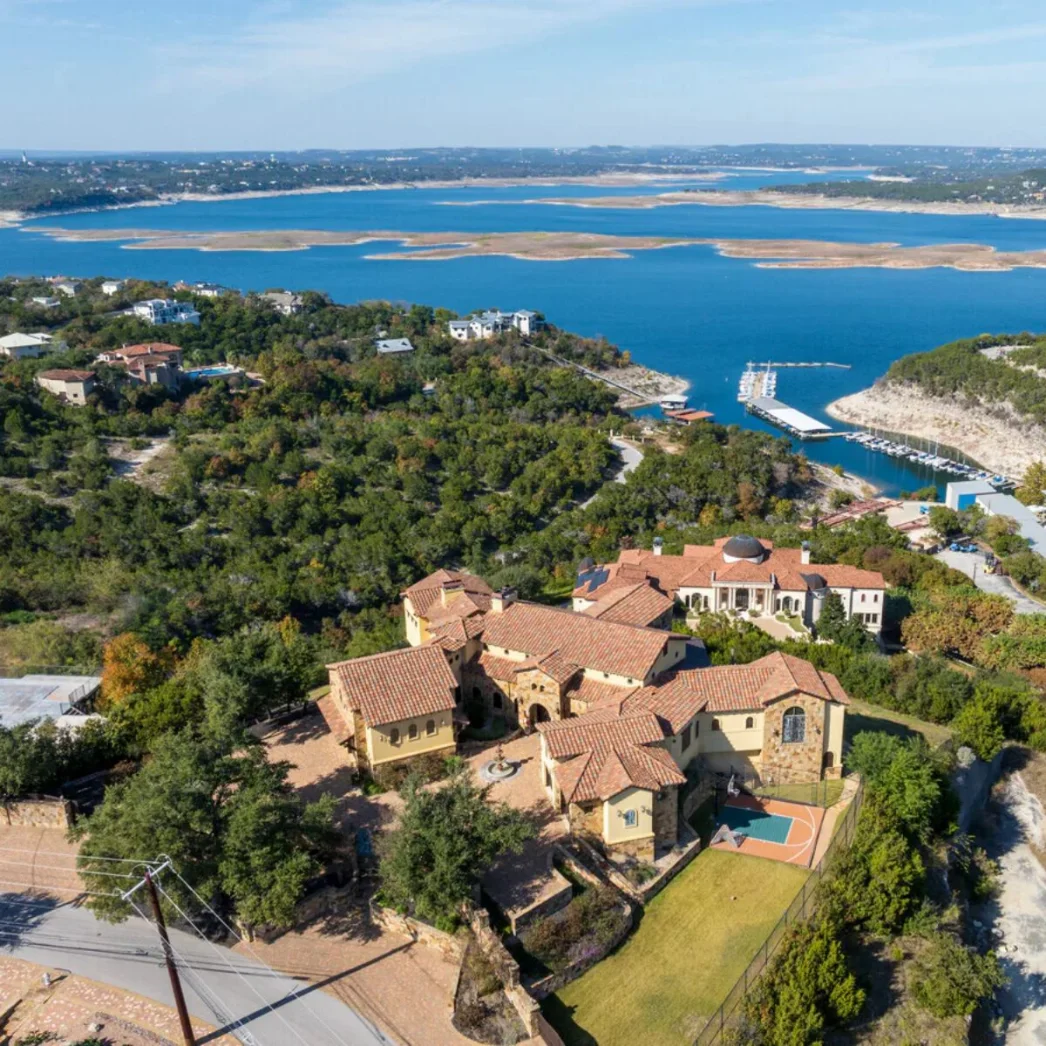
A roughly 4,000-acre luxury enclave in the Hill Country southwest of downtown, built around the Omni Barton Creek Resort and its four championship golf courses. It's split into about twenty gated subdivisions, most zoned to Austin ISD, though a handful of streets, including all of Barton Creek West, feed into Eanes ISD instead. Median list prices for golf-course homes run near $3 million. This is the neighborhood for buyers who want privacy and mature oak cover more than they want to be close to anything.
Search PropertiesWestlake
Technically its own set of incorporated municipalities, Westlake Hills and Rollingwood, just outside Austin's city limits, not part of the city proper, but every Austin buyer with the budget considers it. Eanes ISD is the draw, consistently one of the highest-rated districts in Texas, with Westlake High School ranked among the best in the country. The trailing 12-month median sale price sits around $2 million, and new construction and teardown rebuilds regularly clear $1.5 million to $15 million. Downtown is 10 to 15 minutes away via Bee Caves Road or Loop 360.
Search PropertiesTarrytown
A historic, tree-lined neighborhood about three miles west of downtown along Lake Austin Boulevard, one of the shortest commutes of any established Austin neighborhood. Architecture ranges wildly block to block, a 1930s Tudor next to a 1950s ranch next to a new build, and the median list price sits near $1.7 million. Zoned to Austin ISD, with Casis Elementary, a National Blue Ribbon campus, anchoring the neighborhood. Condos and apartment options exist for buyers who want the location without the full lot price.
Search PropertiesClient Reviews
See What Our Clients Have to Say
Austin, Texas FAQs
Answers to the Most Common Questions About Buying and Selling in Austin, Texas
No, and the gap is wide. Austin ISD's 2025-26 state accountability ratings gave 28 campuses an A and 33 a B, but 11 received a D and 20 an F, with the lowest-rated schools concentrated east of I-35 among Title I campuses. A home zoned to Austin ISD tells you almost nothing about the specific school your kids would attend. We check the assigned campus for any address before you write an offer, not after.
Roughly, in order of price: Circle C Ranch and the North Austin neighborhoods near the Domain start in the mid-$400s. Mueller, East Austin, and Zilker run from the $600s to $1 million and up. Tarrytown, Barton Creek, and Westlake start above $1.5 million and climb from there. Steiner Ranch spans nearly the whole range, from around $500,000 to over $2 million depending on the section. Tell us your number and your must-haves, and we'll point you at the neighborhoods actually worth touring.
I-35 through downtown is the most congested corridor in Central Texas, and active construction on the Capital Express Central project between US 290 and SH 71 is adding delays on top of normal peak traffic for at least the next several years. The MoPac Express Lanes opened in early 2026 and offer a tolled way around some of it, but the free lanes still back up most weekday evenings from Parmer Lane to Slaughter Lane. Neighborhoods like Tarrytown, Zilker, and Travis Heights sit close enough to downtown that the commute barely matters. Steiner Ranch and Circle C mean planning your day around MoPac or 183.
The combined rate for property inside Austin's city limits in Travis County runs about 2.05 percent for 2025-26, covering the city, the county, Austin ISD, Austin Community College, and Central Health. On a $700,000 home, that's roughly $14,000 a year before exemptions. That's usually simpler than the outer suburbs, where a MUD or PID assessment gets layered on top of the base tax rate. Homestead and over-65 exemptions can meaningfully lower the taxable value, and we'll walk you through what applies to your situation.
It comes down to what you're trading. Austin proper gets you a shorter commute, mature trees, walkable neighborhoods, and established resale value, but you pay for all of it. The outer corridor towns we also work, Kyle, Manor, Taylor, Georgetown, and the rest, get you more square footage and a newer build for less money, with a longer drive and, in places like Taylor and Elgin, a market that's still filling in around the new rooftops. Neither is the wrong call. It depends on whether you'd rather pay more for location or trade commute time for space.
Yes. Austin-area home prices peaked around May 2022 near $550,000 for the metro median and have fallen roughly 24 to 27 percent since, sitting around $415,000 to $426,000 as of mid-2026. That's real leverage for buyers that didn't exist three years ago: more negotiating room, more inspection concessions, and builders in the outer submarkets still working through standing inventory. It doesn't mean every neighborhood is cheap. Established, in-demand areas like Zilker, Tarrytown, and Westlake have held their value far better than the outer new-construction submarkets did.
Only with a license, and the rules depend on whether you live there. A Type 1 license covers an owner-occupied home, meaning you live there and rent it out while traveling or rent rooms while present, and it's allowed in nearly all residential zones with no cap on nights booked. A Type 2 license covers a non-owner-occupied whole-home rental, which the city now permits as an accessory use in residential zones with a valid license, a real change from the older rules that mostly confined it to commercial areas. If short-term rental income is part of your plan, tell us before we start touring so we can confirm a property actually qualifies.
Ready to Find Your Place in Austin, Texas?
Whether you’re eyeing new construction or an established home, we’ll help you find the right fit and negotiate the best deal, backed by local Austin area expertise.
Schedule a Consultation